Are you old enough to read this blog?

Thursday, September 06, 2012

"Put It On The Wall, Lou"

"Put it on the wall, Lou"

Here's some serious stuff. In researching this series I came across an interesting phenomenon. 

The overwhelming majority of respondees to these 'Brooklyn' blogs had parents who worked in the neighborhood and most were in retail. "My father owned the bakery on..." "My father worked in the men's shop on Utica Avenue." "My father owned the jewelry store on..." So many of the respondents had families that worked in the same neighborhood in which they lived.

What a quaint concept. No one-hour commute. How totally last century! And the stores were open six days a week. All their lives my grandparents struggled so they wouldn't have to live above the store. I think of that every day on my one-hour commute to work. Any of you who grew up in East Flatbush had a parent who worked in Manhattan? 

I was in junior high school when I decided I wanted my own money, not an allowance, so I went into every store along Church Avenue from Albany Av to Kings Highway. ("Hey, you need anyone to deliver orders for you? Have bike; will deliver!")

Not one of the stores I went into looking for a job was a chain store. The person I spoke to was not a manager, but the owner. Aside from the Woolworth's on Utica Av, the closest to a chain store, was the Carvel on E55th St, but even that was an individually owned franchise.

Speaking of Woolworth's, walking into that store was a throw-back to an earlier life. Wood floors and wood counters. THE place to go to for school supplies. A fun place to stroll through before going to the Rugby. This one was unique - no soda fountain. Just very old sales 'girls'. Even my grandmother, who was far from being a spring chicken herself, would comment about how old the 'help' was with their smocks no doubt designed by the same people who designed the Howard Johnson restaurant uniforms. These factors all contributed to the chain's demise. The name above the store may have been replaced, but there is such a distinctive look that long after, you just know it was a former '5 and dime.'

     
Ok. So I forgot about Ebinger's, started by a German immigrant family in 1898. There was a bunch of them in Brooklyn and by the time the chain went belly-up in 1972 there were 67 in Brooklyn including the ones on Church Avenue, Queens, Staten Island, Nassau and Suffolk.

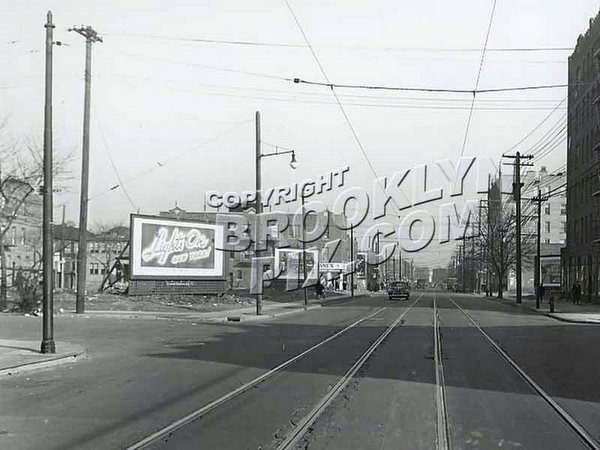
The closest was on Church near Utica (click on the picture here, courtesy of Brooklynpix.com) but their bakery and distribution center was on Bedford near Snyder and if the wind was blowing in a westerly direction, the aroma would not just float over Erasmus; it would sort of caress the school. I still drool, just thinking about Ebinger's layer cake, but hands down, the blackout cake was to die for. Several web sites proclaim to have the original receipe.

Ebinger's also did some miracle work with crumb cakes and buns. Those in the know would just pick off the crumb topping leaving the rest of the family to deal with a virtually bald bun. The stuff was delivered to the stores several times a day in red and black electric-powered trucks that would invariably double park blocking the trolleys.

There was a certain irony in that the large percentage of the chain's Brooklyn customers were Jewish which did not extend to their hiring practices. Ebinger's died a quiet death, allegedly because it did not follow its customers out of the City in the late sixties and seventies, to be reborn as Entenmann's packaged cakes and a Bay Ridge bakery using the signature Ebinger's logo and colors.

How much heartache can one kid endure? Dem Bums moving west and Ebinger's disappearing.

I got my very first job delivering prescriptions after school for a drugstore on Church Av. That won't help you pinpoint the store. There was a drug store on every other block.

I was paid by the number of orders I delivered plus the tips from the customers. It wasn't until years later that I realized how good a deal I had. I'd get the same tip for carrying a bottle of pills as the guy delivering three bags of heavy groceries. Rarely did I have to collect any money from the customer; everything was charged. Not with plastic; but with a pencil and a box full of index cards.

After a while, I'd get to know the regulars and they'd invite me in. ("So, you want I should make you sompem to eat? You look so skinny.") Sometimes they'd tip me by giving me soda bottles to cash in at the candy store for the deposit. That's interesting: Fifty years later the quart bottles have mushroomed to 2-litre bottles, but still command a 5-cent deposit. How did the world of bottle deposits escape inflation?

In high school I went to work delivering for Rubin's Kosher Butcher. And the tips really began rolling in and still the packages weren't as heavy as groceries. Added bonus: I got to ride one of those delivery bikes with the big basket in front. Now, THAT impressed the girls! On rainy days Seymour Rubin would drive me. (He didn't want I should get vet and seeck. It was easier to drive me than to deal with my mother, his customer.) That job lasted through high school. I got two dollars a day for about two hours of work. My first real salary: 2 fives, which my father framed.

If you didn't go to Ebinger's, there was Sutters on Flatbush and Caton or you went to a 'Jewish' bakery. You didn't have to be Jewish to own a Jewish bakery. If it was a bakery and you lived in Brooklyn, it was a Jewish bakery - pronounced as one word. That's it; don't argue; don't ask why. Just get a small seeded rye and ask them to slice it. And make sure it's fresh. Truth in advertising did not apply to local bakeries or fruit stores. "Of course it's fresh! Would I sell your mudda sompem that ain't fresh? Of all the retailers, bakeries had two of the most fascinating pieces of machinery. Sure the butcher had his saw that could cut through bone like it was butter, (a bad analogy, especially in a kosher butcher shop) and the shoe maker had that neat row of grinders and belts and brushes, but bakeries had bread-slicing machines and cord tying machines. You know, those gismos that would wrap a cord around a box in five seconds including tieing the knot. How it do that? And why did your mother save all the cord in the kitchen junk drawer? Especially the green and brown cord from Ebinger's.  That was special occasion string.

Each store had its loyal following. Would you ever think of going into a candy store that was not your 'regular' store?

I lived in an upscale neighborhood. We didn't have a candy store; we had Dave's.  Just plain Dave's  No further explanation required.  It was on a corner, there was a newspaper stand out front.  What did you think it was? And when Coca Cola replaced the old Breyer's Ice Cream sign, Dave's became Dave's Luncheonette and Soda Shoppe accompanied by a price increase. East Flatbush must have been the candy addict capital because Dave had competition on all sides - four within two blocks; one on the same block. How did any of them make any money?

At home our refrigerator had a freezer compartment large enough to hold two ice cube trays.  That's it.  You want side-by-side?  One of the trays would have to be put in the sink.  We'd go to Dave's and order a pint of hand-packed ice cream and we'd stand over him to make sure he packed that container with as much ice cream as it could possibly hold.

Each store had its unique aroma, but none compared to the smell of the fish store. My mother went to Al's on Church near Schenectady. No one could accuse these local merchants of creativity in naming their establishments. The decision centered solely around whether to use the owner's first or last name. If the names were already in use, then just initials would do. Al's offered the freshest fish at the best prices. It was the best. It was the best because my mother knew. Yeah, I know. Your mother also went to the best fish store, wherever it was. Everyone's mother did. Same for the bakery.

Maybe not so for the grocery. Even after a Bohack's opened two blocks away. my mother still patronized Lou's. Not only was allegiance based on proximity but on certain other perks: free delivery and your family's ability to join the hallowed ranks of those to whom credit was extended. I would be sent to Lou's for a container of milk (or 'a milk') and a stick of butter and maybe a measure of sour cream. Never eggs. (It wasn't until I started shaving that my mother would trust me to carry a dozen eggs a block and a half. To this day I still have an aversion to carrying eggs... and seltzer bottles.) After I told Lou or his wife what I wanted, he'd reach under the counter, take one shopping bag just large enough to hold my order, remove the big pencil from behind his ear, lick the point and add up the order on the paper bag. Maybe he didn't got such good English, but he sure as hell knew addition. I would tell him to 'put it on the wall' and every Saturday my mother would go in and Lou would add up all the orders we had bought for the week and my mother would pay. No plastic; just a sheet of wrapping paper on the wall and Lou's big pencil. (What's with the licking of the pencil point???)

Here's something to ponder: Let's say American cheese was on sale for 89 cents a pound and you wanted a quarter of a pound. It never came to exactly a quarter of a pound. as good as he was, Lou wasn't that good, so the cheese on the scale would be a little under or over what you had asked for. How did the Lou's of the world determine the price? And do it before the scale's needle stopped quivering? Did you ever know anyone to question the grocer's math?

OK. For you non-Brooklynites: a container is what you outlanders erroneously refer to as a carton, or quart of milk; a stick of butter is a quarter-pound stick of butter (one-pound boxes would be opened and the individual sticks would be sold separately) and pints of sour cream (a 'measure' according to my grandmother) defy derivation. The best I can conjure up is that at one time sour cream was sold in bulk to the merchant who then ladled out a supply to the customer. Hey, if you can do better, let me know! Also, 'a milk' was always one quart.  If you remember being sent to buy a half-gallon container, you are too young to appreciate this blog.  It wasn't until much later that milk started being sold in larger-than-quart containers.  By the way, the half-gallon containers helped signal the death knell for home delivery of milk.

Going to the appetizing store to buy lox (smoked salmon to those of you who might have just landed from Iowa) was close to a religious experience. The slicing of lox added new meaning to the word 'thin.' An eighth of a pound could serve a family of six. A pound of lox? You bought a pound maybe for a bar mitzvah.  Forget your definition of thin.  Thinly sliced lox meant you could see through it.  Rumor had it that our favorite appetizing store on 48th and Church, hired moonlighting surgeons to slice lox

There was even an art to applying the lox to a bagel. I grew up in a 'dot' house. This meant you took a small slice and to make it last you cut it up into even smaller pieces and placed it strategically over the cream cheese so that each bite would have some lox. This process paved the way for the splitting of the atom, which was a piece of cake in comparison. Rich people put an entire slice of lox on their bagel. I used to dream of someday being rich enough to do that. Gentiles sometimes did that when they wanted to 'assimilate,' or wanted a change from the usual corned beef with mayo on white bread diet.

The only way to buy halavah was from an appetizing store. The clerk would cut off a piece from a giant hunk and weight it. The pre-packaged stuff is good, but does not come close to buying it from that giant hunk.  While we're in drool mode, think about those chocolate covered jelly candies and all those other goodies strategically placed at waist height for a six-year old?

Next session we'll touch on a sub category of merchants - the street guys. Later blogs will delve into the exotic culinary world. How old were you when you learned that exotic cheeses did not include Velveeta or any cheese you spray on a cracker?


Saturday, August 18, 2012

FWIL - RIP

(originally posted 2007 - then edited 2009 and again in 2013- worth re-reading update with some background info.)

Special occasions in our family were celebrated with food. You graduated from kindergarten? Let's eat out. You got accepted to your fifth choice college? Let's eat out before you move to Idaho and we'll never hear from you again. Promotion? How about if we celebrate with a fancy meal before you get to be such a big-shot you won't want to eat with your family that loves you.

Special occasions did not always mean happy occasions. "Hey, we never liked him anyway. Let's celebrate by eating out to take your mind off the jerk.

And, if you were looking for a truly special place to dine, there was no place more special than F.W.I.L - Lundy Bros. And you could be assured your special occasion would be shared with up to three thousand of your fellow Brooklynites - more on really special days like Mother's Day.

Come on. You know a trip to Lundy's was a special occasion. Not the every-Sunday type of occasion that warranted a trip to Fong Fong. We're talking about the original Lundy's - not the puny remake that emerged in the nineties that could seat only seven or eight hundred people. I'm talking about the original - and according to some - the largest restaurant in the United States, if not the world, with seating for close to three thousand! How's that for intimate dining?

Hold on a minute. Before you get all upset and claim that Lundy's is/was in Sheepshead Bay and not East Flatbush, let me explain.

There were some areas in the borough that were 'non-neighborhood': Flatbush Av, Downtown, the Highway, the Junction. There were some institutions that belonged to the borough and not to a particular neighborhood or high school: the downtown theaters, Brooklyn College, the main public library on Flatbush Avenue, Prospect Park, the zoo, the beaches, Ebbets Field, and ... Lundy's, for example.


First, stop trying to figure out the names of the Lundy Brothers.  Here's the scoop: One guy. Frederick William Irving Lundy opened the restaurant in 1934 as an adjunct to his family's thriving fish business.  One person's name.

The original restaurant was a seafood shack perched on a dock in Sheepshead Bay which was condemned by the City in the 1930's as part of a neighborhood renewal project.  The new two-story Lundy's was built on the site of the old Bayside Hotel at the corner of Emmons and Ocean Avenues

You just didn't walk in to Lundy's, wait to be seated, wait to be served.  No. Lundy's was not for the feint of heart. You did not want to take your great aunt from Boise there. First, there was no maitre d' and no reservation. The restaurant was a city block long and had two kitchens and multiple dining areas.

Yeah, and your parents had a favorite waiter who remembered your family from three months ago. Yeah, right!

One of the vivid memories I have of eating at Lundy's was the act of securing a table.  Assuming you made it inside the restaurant after waiting outside, finding a table was left up to the customer. My father would elbow his way through the large dining room, lead his family upstairs to the long narrow room facing the Bay, find a family nearing the end of their meal and then hover territorially nearby.  Typically, the law of the jungle would prevail; rarely was there any dispute.

Also, there were the rituals: You were given a lobster bib and the after-meal cleanup involving a finger bowl with lemon-scented water.  In retrospect, it was not unlike a religious event.  (I wonder if the waiters ever bet each other to see how many of their customers would try to drink the contents.)

Lundy initially insisted on hiring only blacks for his wait staff.  From the captains to the busboys, the 200 or so front line employees in their starched uniforms were African-Americans.

Close your eyes (after reading the rest of this paragraph) and think about the Lundy's Shore dinner: for starters, a basket of steaming hot miniature biscuits accompanying a shrimp, clam or crab cocktail; steamed clams, half a lobster, half a chicken, potatoes, vegetables, coffee and dessert.  Not just any dessert, but if you had been there before you knew what to order: hot blueberry pie with Breyers vanilla ice cream.

OK.  I'm back.  Just wanted to see what was in the refrigerator.

Lundy's outlasted the Depression and World War II.   It thrived through the '50's and '60's.  Little changed in the way the restaurant did business, but its surroundings were changing.

Little by little, the middle-class neighborhood residents, who had made up the bulk of its customer base were relocating to the suburbs and by the 1970's the restaurant was no longer profitable.

And in 1979, just months after Irving Lundy's death, the restaurant - to the great dismay of its loyal customers -  closed its doors.

Until sixteen years later, when smaller Lundy's opened under new ownership with seating for only 800 diners.

Hey, How much bad news can a person take?

First, The Dodgers, Trolley cars, Ebingers, parking meters, Tilden going belly up. Now, Lundy's is history - for the second time.

And now, even the puny off-shoot is shuttered.

Here's a further update. The property owners are thinking of turning the place into a food store!


Ain't nothin' sacred no more.


Monday, December 25, 2006

Parking Meters and Egg Creams


Waddaya mean you don't see no connection?

You're right. They don't have anything to do with each other.

I usually don't read obits, but this one intrigued me:
The last New York City mechanical parking meter - an emblem of street life since 1951 was withdrawn from service recently.

Before you rejoice and decide to move back to the City from Boca or wherever it's always beautiful weather, read on. The meters have slowly been replaced by more than 62,000 battery-powered digital meters that the City finds more accurate and vandal-resistant.

In a somber but unpretentious ceremony somewhere in Coney Island, the last mechanical meter was replaced by a digital version ready to take quarters.
 Quarters? What happened to dimes?
I remember dime meters on Flatbush Avenue and then along Church and Utica Avenues. And not the type that required the driver to twist a handle after inserting the coin. Just put the coin in the slot, listen for the gears winding or more likely inserting the coin and waiting for nothing to happen before pounding it on its side to jiggle the coin enough to engage the gears. The latter took some finesse.

Parking meters came to New York somewhat late in the dance. They were first introduced in Oklahoma City in 1935. How's that for embarrassment? Scooped by Oklahoma City! I'm sure that really alleviated the parking crisis in downtown OC.

Anyway, it took sixteen years before New York realized that it was letting a lot of dimes - and quarters - to say nothing of slugs and foreign coins, to slip through their fingers. The meters were first installed on West 125 St, and it sure didn't take long for the fungus to spread to the 'outer boroughs.'

Those original meters required weekly winding by some guy walking along the curb with a crank, winding each meter. (Another occupation replaced by modern science and after all that special training you went through to get that job! ) But, the job that really impressed me was the guy who emptied the coins from the meter into a 2-wheeled canister with a long vacuum-cleaner type hose.

Now, that was a job! Just think of the possibilities. Think of all the promotional opportunities that must have been turned down once you got that job. "No, sir. Thanks for the offer, but I really don't want to be borough president. I think I'll just stay down here in the Department of Traffic doing the same boring job out there on the streets I've been doing for 23 years, collecting all those dirty coins for the City I love and making sure they all get into this canister I drag around every day."


A side note for all you ex-pats out there. It no longer costs a quarter for an hour of parking. For that lone quarter you get 10 to 12 minutes of parking. That could be why the City has installed meters that can accept coins or credit cards and/or parking cards. How thoughtful. There is no longer a need to carry a roll of quarters. There are were about 600 meters that accept credit cards.

There must be a lot of folks feeding these machines. In a recent year, the City took in more than $96 million from those meters.

Here's a further update.  Those digital meters have been replaced by muni-meters.  First the meters were removed, leaving only the hollow poles until the City got around to removing them.  I'm sure that the overly honest drivers just dropped quarters down the hollow tubes.  At the other end of the moral spectrum are the citizens who just yanked the poles out of the sidewalk and sold them for scrap metal. 

In any case, now once you've found a parking spot you then have to locate the nearest muni-meter (There's usually two or three per block conveniently disguised as all the other street stuff you find along a curb.)  Determine how much time you need to buy and how you will pay for it (cash or credit). Then run down the block, pay for your parking, run back to the car, put the receipt on your dash - all while looking for the parking enforcement agent.

Figure on about three dollars an hour  A lot of years ago I was in some town on Long Island.  Pulled up to a meter, put in a penny and got twelve minutes of parking.  Since there was already 40 minutes on the meter I felt I had beaten the system.  By the way, many of the digital meters have a sensor that puts the timer back to zero when the vehicle leaves the spot.  Saves you the time and grief of looking for a spot with time on the meter so you can save a dime.  (Don't tell me you didn't do that years ago!)

I'm getting too old to handle all this change.

Well, I was so distraught over another loss from my youth (Ebbets Field, trolley cars, Ebingers, Tilden High School, and now parking meters) that I decided to drown my sorrow, literally, in an egg cream.

Anyway, I could not find a decent egg cream, let alone many who knew what an egg cream is. Anyone out there know where the name came from? Why 'egg'? Check this: a current neighbor who grew up in Bay Ridge seems to remember an egg cream made with CREAM SODA!!! (That's why your mother told you never date anyone from any number street that didn't have 'East' in front of it.)

Decided to see if I could recreate an egg cream on my own.


Fox's U-bet Syrup - a Brooklyn institution long before Ebbets Field was conceived.
The only syrup allowed in an official 'egg cream.'
 
Just as Brooklyn bagels taste better than bagels from any other city, so too, with egg creams.
 
As a public service, the following is the recipe for an 'official Brooklyn egg cream' from Fox's website:

  • Take a tall, chilled, straight-sided 8 oz. glass
  • Spoon 1 inch of U-bet chocolate syrup into glass
  • Add 1inch whole milk
  • Tilt the glass and spray seltzer (from a pressurized cylinder only) off a spoon, to make a big chocolate head
  • Stir, drink, enjoy
It didn't taste the same!

By-the-way: No more glass jars; only plastic squeeze bottles. For those of you who insist on scooping your syrup out of a hard-side container, Fox's U-bet is available in 55-gallon drums. (No kidding!)

Wednesday, December 20, 2006


This is a response to the previous installment announcing the demise of Tilden High School. The story, in part, appears courtesy of Sam Roberts, class of '64 and The New York Times.


WHEN TILDEN WAS THE WORLD
By SAM ROBERTS
Published: December 17, 2006
THE REV. AL SHARPTON and I don’t have much in common — but we do share a defining backdrop for our wonder years in Brooklyn. At different times, we both attended Samuel J. Tilden High School.

And both of us were chagrined by the announcement Monday by the New York City Department of Education that Tilden — deemed unsafe and unsalvageable academically — would be closed and replaced by a cluster of smaller and presumably more manageable institutions.

Tilden alumni are hardly slouches. In addition to Mr. Sharpton, they include the Mets manager Willie Randolph, the labor leader Victor Gotbaum, the former White House counsel Leonard Garment, the writer Murray Polner, the jurist Milton Mollen and the weightlifter Dan Lurie.

Sid Gordon batted for Tilden before joining the baseball Giants. Ronnie Blye broke scoring records at the school before playing for the football Giants. The folk humorist Sam Levenson, though not an alumnus, taught Spanish there in the 1940s.

Jake Ehrenreich, whose memory play, “A Jew Grows in Brooklyn,” opened Off Broadway in October, not only graduated from Tilden but also makes his entrance on stage wearing a Tilden sweatshirt, emblazoned with a giant T.

Tilden, which opened in 1930, was built to accommodate about 3,800 students. But within a decade, enrollment swelled by 50 percent. I grew up about a mile away, on Kings Highway, one block from the hulking New Lots el, which more or less defined the border between East Flatbush and Brownsville. Almost overnight, Brownsville, heavily blue collar and lower-middle class, would be recast from Jewish to black. We lived in what we considered solidly middle-class East Flatbush, which I deluded myself into thinking was an integrated neighborhood because an Italian family lived on our corner.

Also, I like underdogs, and like almost everybody at Tilden during those years, I knew that its namesake was a New York governor who had won the popular vote for president in 1876 but been deprived of the job because supporters of Rutherford B. Hayes had stolen the election in Congress.

The school wasn’t perfect. As early as 1958, a police officer was regularly stationed outside. We abandoned the annual Thanksgiving football rivalry with Jefferson High School ... because more injuries were suffered in the stands than on the field.

After last week’s announcement by the Department of Education, I dug out my 1964 Tilden yearbook. Since we graduated on the stage of the old Loew’s Kings, I’d been in touch with a handful of Tildenites and knew what had become of them. Robert Ellman became a teacher, just as he’d predicted in the yearbook. Marilyn Schwartz became an educator, too, and acquitted herself in the thankless role of spokeswoman for the school district that includes Columbine High School in Colorado. Paul Nussbaum had said he wanted to be a politician; he became chairman of a giant hotel chain.

Most of the girls said they wanted to be teachers or stenographers. One boy wanted to be a roofer. Was that really what they aspired to? ... Did Ilene Kleinman become a psychiatrist? Did Philip Asher become a choreographer? Judy Gitlin had been voted most likely to succeed. Did she? At what?

At Tilden, fewer than 44 percent of students scheduled to graduate last June did so, and only half of those got a Regents diploma.

In the 1930s, Tilden established the school system’s first guidance department to effectively deal with what was quaintly described as juvenile delinquency. Now it is considered one of the city’s most dangerous schools.

In the Tilden I attended, nearly 98 percent of the students were classified as “others,” a euphemism the Board of Education used to designate people who were neither black nor Hispanic. Still, the mix of ethnicities and religions made the school much more multicultural than any place I’d ever been.

By the time Mr. Sharpton graduated, the proportion of “others” had shrunk to 63 percent, which was still considerably more than he would have encountered if he had stayed put on Lenox Road.

Right around the time Mr. Sharpton was attending Tilden, Sam Levenson was asked how the old neighborhood had changed since he taught there. More mixed, he replied. “No matter where I go, or how successful or unsuccessful I am,” he explained, “I never in my life shall ever feel that ‘they’ are coming. There is no ‘they’ to me, because I know about being ‘they’; I have been ‘they.’ ”

Tuesday, December 12, 2006

Hold On To Your Tilden Sweat Shirts, Folks


From the official Samuel J. Tilden High School website:


www.tildenhs.org/ Brooklyn 5800 Tilden Ave Brooklyn, NY 11203


The staff of Samuel J. Tilden High School is a staff committed to excellence. This excellence will be evidenced in the development of out future leaders. It is our plan to insure that the young people that graduate from these portals are prepared with the social and academic skills necessary to achieve in an ever changing, technologically developing world. Within our young people we will reinforce the positive values that they bring from their homes and their communities. As they develop a sense of self-worth and dignity, they will also develop a strong appreciation for their own culture and respectful tolerance for the lifestyles of others. We will reaffirm the necessity for our youth to be academically prepared, socially concerned, and intellectually discerning human beings who will feel confident and adept in an ever changing multicultural and multifaceted environment.
Well, it seems that not everyone agrees with the above statement. Certainly not the New York City Department of Education ('Board of Education' to us Boomers) who on December 11, 2006 said that it would close five failing high schools that had proved unsalvageable.
That honorable distinction was bestowed on Tilden, as well as Lafayette and South Shore, and two small Manhatten schools.
The Brooklyn schools will be replaced by collections of small schools with about 400 - 500 students, typical of the Bloomburg administration, which has closed or is in the process of closing 17 other large schools across the City.
Education officials said the schools to be closed had notably low four-year graduation rates, did a particularly poor job helping students who were already behind as incoming freshmen, and proved exceedingly unpopular with prospective students.
In addition, the schools all had safety problems. Extra police officers and security guards were put into each of them after each school was named an 'impact school.' (South Shore and Lafayette were taken off the list after improving.) Hey, remember when Ralph was the only cop assigned to the school and there probably wasn't enough for him to do.
At Tilden, 43.5 percent of students scheduled to graduate in 2006 did so. (What was the graduation rate the year your graduated? Did you even know anyone who did not graduate?)
Don't throw away your Tilden keepsakes.
They're sure to become great conversation pieces. You can tell your grandchildren that you remember when Tilden was a great school in a great neighborhood, in the best borough of the greatest city.
A sad day.

Wednesday, November 15, 2006

Class Jobs - more


I don't remember class presidents prior to the fourth grade, but from that point on until I got into junior high school we always had a boy president - not that it really mattered because the president didn't do squat. Every year the boys would decide who they wanted as president and then procede to nominate at least two girls.

Duh!

It was simple. Boys voted for the only boy; girls split their vote between the two or more girl candidates. There was no platform; no promises; but lots of patronage. (More about patronage later.)

Who knew then that we were being prepared for the real world.

Every year the same drill, with the same inevitable outcome.

The president had real power - unless the teacher didn't like him which was the case with any boy duly elected. So, the teacher would appoint a monitor - the kid who would be sent to the main office to retrieve messages or supplies, but more importantly he or she was the rat, the stooly who would stand up in front of the class when the teacher left the room. When the teacher returned, the monitor would report all the miscreants and their often exaggerated crimes. Recently, a federal law was enacted to protect whistle-blowers and I'll bet Congress had these class monitors in mind when they drafted the law.

I had taught for a while at Abraham Lincoln High School (It was NEVER Lincoln High School.  Either Lincoln or Abraham Lincoln High School) but it wasn't until I joined Meyer Levin Junior High School that I perfected the fine art of patronage. If I had twenty eight kids in my class, my goal was to give each one a job. And they loved it! There were so many kids in my official class doing 'stuff' that I thought about assigning student supervisors.  I was once late to class and when I came in every one was doing his/her assigned job.

Hampton Gathers was my favorite. First, I loved the name. Some days I would call on him five or six times a period, just to hear the sound of his name. Hampton Gathers. He was my main man. This kid was ultra cool before cool was even invented. He was what I unofficially called our lollipop monitor. As important as his job was, it was, at best, a part-time assignment. But Hampton embraced this job with his whole being.

Let me refresh your memory.

Every room had a round red sign, about twelve inches in diameter. Stenciled on each side was the room number. And this sign was attached to a wooden dowel about the size and length of a teacher's wooden pointer. During a fire drill, and other occasions requiring evacuation of the building, the teacher was expected to carry the sign aloft as he and the class behind him left the building. This way, the class, in the ensuing frenzy could easily reassemble.

Now, on paper, this sounds like a plan.

And if there was one thing this teacher shared with his students, it was the opportunity on some early spring afternoon, when the leaves are just beginning to bud, to leave the building for a nice stroll out Beverly Road and left along Ralph Avenue, cross Tilden Avenue and observe the miracles of nature and possibly make a quick detour toward Tomain Joe's Luncheonette.

What this teacher did not particularly like was having to carry the silly sign in the building, let alone out in the street.

Hampton Gathers to the rescue. My main man.

"Had this been a real emergency you would have been instructed to get out of Teacher's way unless you can run faster than him." 

Hampton was pressed into service maybe three times that year and on one occasion for an unexpected fire drill. The latter caused major administrative concern. The smart money put the blame on Hampton who vigorously denied any wrongdoing. Everyone knew it was not a scheduled fire drill because it wasn't a particularly warm day; Dr Herselle would never schedule a drill where students might be required to put on coats. And the last thing he wanted was a posse of piqued panicked parents parading into the principal's office.

My absolute best student assistant was Carol G. On the first day of class, my first day in the school, Carol told me I would need a class secretary and she would be happy to be that person. She was in my 8th grade SP official class.

Any way, Carol, at the ripe age of 13, was better organized and more mature than most of the secretaries I've had since leaving teaching. And, she could print like a typewriter.  Remember, this is before computers. I mean this kid was great. Carol's arrival signalled the end of most of my administrative duties. (She later expanded her duties to be our son's babysitter. How neat was that?)

There was one job in junior high school, because of its importance, that could not be relegated to students. During passing between classes, all teachers were required to stand outside their classroom to observe the flow of student traffic. For what? To break up fights? In Meyer Levin in the sixties? To watch for kids passing on the right or weaving in traffic? Ha! Pity the poor student who inadvertently made a left turn across oncoming traffic to enter a classroom without first going to the designated u-turn area, so marked on the corridor floor with turn arrows. Amazing the power of the system. Three years in the school. I don't think I ever saw a kid knowingly cross that line and if he had, what punishment is appropriate? Well, technically it is a moving violation.  We may have to bar you from graduation ceremonies.  I used to like calling a kid walking on the other side of the hall to see me and see how they would react. Invariably the student would walk forty feet further down the hall, make a u-turn at the designated arrow and come back to where I was standing.  By that time I had forgotten what I wanted to say.

I don't know if teachers were exempt from the white line rule, but until I got tenure, I wasn't going to take any chances.

One more chapter on Meyer Levin - its teachers - and then we'll mosey through the neighborhood again. I'd like to hear from some of you who lived east of Ralph Avenue. No, not you, Billy. You lived south of Flatlands Avenue and that was Canarsie - or Flatlands. Definitely not East Flatbush.

Thursday, September 21, 2006

Street Merchants


Update to this article:  Wow, did this generate interest!  All the mobile food vendors. Buy a truck and a grill.  Fry some food and bingo, you're in the restaurant business.  Sixty years ago we thought it was exotic.  "Hey ma, I bought an egg roll offa dat truck an' I still got money for ice cream."  Compared to today, it was truly primitive. Let's save that for another discussion.

We did most of our daily shopping on Church Av - there was no need to go elsewhere. The closest thing to a mall before there was a Kings Plaza was Flatbush Av or Kings Highway near the Brighton subway station or Pitkin Avenue.("So, where else to shop for a Bar Mitzvah suit?")

But there was an entire retail world that came to our door. There were the obvious 'seasonal' vendors. The ice cream guys in the warm weather. In our neighborhood, the Good Humor man reigned supreme. We're talking about a specially designed pick-up truck with a roofless cab. (In bad weather there was a canvas roof that could be unrolled.) The poor Bungalow Bar guy came in a distant second. He had to endure some very unflattering elementary-school poetry and even more damaging rumors regarding the cleanliness of the product. The latter ultimately contributed to the company's demise. (What do you think happened to those neat
trucks with the house roofs?) For a while, even Howard Johnson's got into the frey and then there was a bunch of independent operators. (One summer I went on a banana ice cream binge sold only by some independent guy with a truck that got washed once a season which coincided with his own showering. Fortunately, I overcame this lapse in culinary judgment.)

It wasn't until several years later that Mister Softee came on the scene and the days of the white-uniformed ice cream men who actually rang bells would join the ranks of horse drawn wagons.

Well, not quite.


There was the junk man with a horse-drawn wagon with a bunch of cowbells jingling on the back and in a somewhat related industry, the rag man.  The rag man must have been related to Pop, the hot knish man.  Same stature, same vintage, same origins.  I spent the better part of my youth trying to figure out what he was saying: "I cash clothes."  Not a clue, but everyone else on the block must have understood because they'd all run into their houses and come out with unwanted clothes.  After some obligatory haggling he'd stuff them into a giant pack on his back that must have outweighed him  and he'd shuffle off.  No one ever questioned what he did with the clothes.  He was ultimately replaced, not with a machine or a truck, but with a giant clothes bin unceremoneously located in a parking lot or at the edge of a gas station.

The vegetable vendor with his hand-lettered prices written with black crayon on a shopping bag also graduated from a horse-drawn wagon to a converted and repainted school bus and raised his prices accordingly. Other than my summer day camp rides to Broad Channel Day Camp on a school bus, Vegetable Joe's converted bus was my only school bus experience. Come on, did you know anyone who rode to school on a school bus in the fifties and sixties? This was Joe's 'store' in an earlier life.

The knife sharpener guy intrigued me. He announced his arrival with a special sounding gong. He also advertised that he would sharpen lawnmower blades. I mean it. He even had a picture of one painted on the side of his truck. Now there was a dreamer! Lawnmowers? Who had a lawn? My mother would save the scissors and dull knives for the day every two weeks when the sharpener guy would show up and it was my job to flag him down. Then, run back to the house and get the scissors and walk carefully and slowly, very slowly, to the grinder. Very slowly. "Stand back folks. Don't go near the kid. He's got knives." It was like the scene from "Dead Man Walking."


And then there was the horse-drawn hand-cranked merry-go-round wagon. The wagon was ultimately replaced with a truck-mounted 'whip' ride, which indirectly provided an unexpected lesson in centrifugal force as it pertains to a not-fully digested meal in a young stomach. Spectators in the know, and even loving parents, learned to stand a respectable distance from the ride.

The ice man not only cometh but wenteth. By the time I joined the human race there weren't too many people on our block with ice boxes - in spite of what my grandmother called the refrigerator. So, most of the ice man's business was with the retailers on the Avenue. He, too, joined the mid-twentieth century by forsaking his horse for horsepower but still retained that awesome ice crushing machine. Drop a giant cake of ice into the hopper and out came crushed ice. Or, cakes of ice were handled with a giant set of tongs and hoisted onto the iceman's towel-covered shoulder for delivery to the customer. I can still hear the sound of that machine. If it could do that to ice, what would it do to human bones? It didn't seem to bother the horse, though.  The horse had other things to worry about - like career alternatives.

Rivaling the competition between the ice cream vendors was that between the Dugans and Krugs packaged bake goods drivers. What ever happened to them? Dugans went stale in October 1966. Krugs? Who knows. Who cared?  There was always Ebingers!


dAnd finally, there was the milk delivery: Borden's, Sheffield/Sealtest. In real glass bottles. The Borden's products came from Utica and Kings Highway in what at one time was a stable. And they drove those neat Divco trucks while standing up. Refrigeration consisted of throwing a couple of ice cakes in the back to preserve the milk. Divco engineers followed the same styling concept adopted by Checker taxis. Hit on a decent style and stick with it - forever. Both Divco and Checker are out of business. 

Hey, wanna know sumpin?  The milk deliverers weren't crazy about giving up their horse drawn wagons.  Seems the horses weren't as dumb as we think.  After a while they knew the route. And, if there were several stops on a block, the driver could get out carrying enough bottles for all his stops on the block and go from house to house without having to get back on the wagon.  The horse would just follow along and know where to stop. No truck could do that.  Didn't matter; the horses were replaced.  Done deal! 

By the way,  I was never sent for a quart of milk.  It was,"Go to Lou's and get a milk."  Later on, it was "Go to Bohack and get a container of milk."  Sending a kid for milk was easy back then. Ever check out the milk display case in a modern supermarket?

What ever happened to those flat-topped Canco containers with the lid in the corner? 

Here's another by-the-way:  Milk, when you were growing up came only in quarts.  The advent of half-gallon containers signaled the beginning of the end for home delivery of milk.

Cross the Hudson and people look at you kinda funny when you call it a container when what seems like the rest of the world calls it a carton.

Who did I miss?


Sunday, August 27, 2006

A Road By Any Other Name


I guess I'm not quite finished with the street name change thing. Please indulge me. This won't take long.

The neighborhood, East Flatbush, started life as Rugby, (hence the Rugby Theater, The Rugby branch of the Brooklyn Public Library, the Rugby post office.  Get it?) yet you have to travel to the equivalent of E14th St to find a Rugby Rd in the heart of what is now Ditmas Park and its million-dollar Victorian mansions. Rugby Road starts at the Parade Grounds at Caton Av and ends around Av H where it assumes its more pedestrian E 14th St.

I had a friend who lived in an apartment house on the corner of what is now Dr. Wesley McDonald Holder Av and Detectives R. Parker and P. Raffery Way.

(Try giving that address to a cab driver!) The names honor local residents and the intersection is Schenectady and Snyder Avs.

'Schenectady' isn't one of those words that just rolls off one's tongue, and it sure isn't easy to spell - not like Utica or Troy or Albany. OK. 'Rochester' was already taken, but there have to be easier names.

I've tried to figure a pattern for the street names along Church Av or Linden Blvd between New York Av and Kings Highway . 

New York Av is the equivalent of E35th.

Brooklyn Av, the equivalent of E36 St, sneaks in and messes up the theory but the next wide street is six blocks east of New York Av- Albany Av(E41st); followed by Troy Av (E44 St) and then Schenectady (E47) and Utica (E50).

The wide streets have upstate names. And at three-block intervals. But, why no names for E53rd or E56th? And why are some two-way streets?

Well, back to Schenectady Av. It's interesting that it's the only named street that most people from the neighborhood feel more comfortable referring to in writing as E47th.

Want to know if someone is really from Brooklyn?  Ask them to pronounce Nostrand Av.
NOS trand?  No way!  NO strand? Way!

Well, I apologize for the digression. Thank you for your patience.

Next session, we'll talk about commerce in the neighborhood. Where we bought stuff; where we ate out; what we did for fun that wasn't free.

Saturday, August 19, 2006

What Ever Happened To Linden Ave? Deehan Ave? Wilde Lane?....


surprise quiz - match the original street name (column A)with the one you remember from the sixties (column B):
column A

Grant
Wilde Lane
Vernon
Linden Av

Deehan Av
and, so you don't feel like a total loser:
E 44 St


column B
Linden Blvd
Troy
Tilden
Linden Blvd (2)
Snyder
Church Av
See the bottom of this blog for answers. No cheating! No help from your parents!

Before we begin, did you read the posting in the column to the right?  Did you read the blog that appears below this one?  Good!
The picture, courtesy BrooklynPix.com, at the upper right of this blog is what is now Linden Blvd looking west at Utica Avenue toward E49th St taken in 1924. If you look carefully, that tall building on the left, about two blocks away is PS 135. The tracks in the foreground carry the Utica Avenue trolley. Check out the cobblestones. Smooth roadway had not yet entered the lexicon of road builders.
There were some major thoroughfares that took us out of the neighborhood, but none could offer us the vast
opportunities afforded by Linden Blvd. Whereas Church Avenue and Utica Avenues provided easy transport to all three subway lines and various connecting surface lines, their ultimate destinations were all within the confines of the five boroughs. Even Kings Highway - my, what a regal name - while it meanders through so many Brooklyn neighborhoods and grows to an eight-lane giant by the time it reaches East Flatbush (yeah, the Department of Traffic considers the curb lane as a lane, even though it's primary purpose is for parking) it meets an ignoble, and some may say, untimely end at Howard Avenue in East New York. Even Utica Avenue at its southern terminus contributes to Flatbush Avenue's march toward Floyd Bennett Field and the Marine Park(way) Bridge.

In all fairness, even Linden Blvd has a humble beginning, with its start at Flatbush Avenue between Caton and Church Avenues as a one way eastbound street. How many of you have ever visited the Flatbush branch of the Brooklyn Public Library on Linden Blvd just east of Flatbush Avenue?

If you were fortunate to grow up in a family with a car, NY Route 27 - Linden Blvd - was the way to get out to the country. Route 27 starts at the Gowanus Expressway, shares the right of way with the Prospect Expressway and then heads east on Caton Av until Bedford Av where Caton ends and makes a slight left turn to join Linden Blvd. At this point Linden Blvd is flanked primarily by six-story apartment houses, interspersed with the occasional two-family house. While not high-end, the houses do exude a degree of upper-middle-class class - many had doormen, at least in the nineteen thirties and forties; by 1960 they had long-since peaked. By the time the traveler reaches New York Avenue there are more and more four-floor 'walk-ups.' No elevators! And more two-family homes.

I've been unable to confirm this, but while I was growing up on Linden Blvd rumor had it that the white line down the center of Linden Blvd separated more than just the on-coming traffic. It allegedly also served as the boundary between the six-seven and the seven-one police precincts, now part of Brooklyn South. The word was, 'Don't ever get hit by a car while standing on the white line; neither precinct would respond. Drag yourself to either side.'

Further east, probably around New York Av, the white line (yes, 'white'!) also served as the boundary between Erasmus Hall and Wingate High Schools, once the latter opened in the late fifties.

There is nothing of any architectural significance until Albany Av and St. Catherine’s RC Church and school. If you lived in the neighborhood and you were Catholic, you went to St. Catherine's. As a result, the local elementary school, PS 235, on Lenox Rd at East 39th St was predominantly Jewish.

Seven blocks east was East Flatbush Jewish Community Center, on the corner of Schenectady Av. Well, actually, not on the corner. The plan was to build a sanctuary on the vacant lot on the corner and convert the original building into a community center - a dream that never materialized. The building is now a church. Diagonally opposite is PS 135, an imposing five-story building that was old sixty years ago. And a block further, across the street was a brand-new health care facility. (Help me out folks: I think it was a nursing home. Interboro?)

I bought my first tank of gas at the Texaco gas station on Utica and Linden. (27.9 cents for regular, leaded gas and they checked my oil!). 1959 was a very good year. I learned every bump and pot hole on Linden Blvd.

The Rugby library's first home was east of Utica, in a row of stores on the north side of Linden Blvd, before it moved to a new, larger building on Utica and Tilden Av.

Linden goes through another change east of Kings Highway. The intersection of Kings Highway, Remsen Av and Linden Blvd has to be the most pedestrian-unfriendly intersection in the City. (Actually, in 2003 there were 92 accidents at the intersection, ranking it the fourteenth most dangerous intersection in the City. In the early fifties there was some talk and plans were proposed to make one of the roadways under ground.  No doubt the plans were left on the center island of the intersection and no one was brave enough to retrieve them. Pennsylvania Av at Linden Blvd was more dangerous - 103 accidents that year.) Anyway, on its steady march to the 'country,' Linden Blvd now becomes an eight-lane monster.

Linden Blvd had an interesting traffic control arrangement as it sliced through East Flatbush. Not every intersection had a traffic light. Small signs well-hidden on lamp posts at each corner advised drivers to stop at the intersection if the light ahead of them was red. In most cases the lights were at three-block intervals. For example, Albany Av had a light and the next eastbound light was at Troy Av. The next light was at Schenectady Av, three blocks to the east and then another three blocks at Utica Av which sported an overhead signal. This traffic control concept might have been successful had it been a universal policy throughout the City or if Linden Blvd were in the middle of a desert with no foliage growing in front of the traffic lights or the small signs.

Traffic lights were black four-sided box-shaped lights which were effective only at intersections that were true right angles. They were mounted on stantions about ten feet high at the curb on the corner. Usually two signals controlled an intersection, mounted diagonally across the street from each other. And, they were absolute. Either the light was red or it was green, and the second the light turned red for one direction, it turned green for the waiting traffic. In a nod to fairness, the Department of Traffic experimented with the equivalent of an amber signal. Just before the signal would turn red, both green and red signals would be lit. In New York, that was typically viewed as a signal to speed up.

Now, for the poor hapless driver waiting, say at East 43rd St., to cross Linden Blvd. He was instructed via a small sign where normally there would be a stop sign to look in both directions to see if the light was red for traffic on Linden so he could cross. Even if it were red, there was a fifty-fifty chance that some Linden Blvd driver would not stop at East 43rd St, but continue on to the next traffic light. Obviously, to make this work, all the lights had to change at the same time. If our hero made it across Linden Blvd he was greeted at Lenox Rd with a yellow stop sign (with reflective bead letters) and another stop sign at Clarkson. Standardized red stop signs were still years away as were three-light traffic signals and progressive signals to keep traffic moving at a steady pace and yellow lines down the center of the street. Someone in the City government woke up and by the end of the fifties, Linden Blvd had joined the ranks of other streets with a more conventional traffic control system.

Although it loses its identity somewhere at the Queens border and becomes North Conduit Rd, it still maintains its Route 27 title as it continues east on The Sunrise Highway which was built in the 1920's to alleviate the congestion on Montauk Highway. It will go through several such changes until 122 miles from its western beginning, it ends at a non-descript traffic circle at Montauk Point.
OK.  A word about Vernon Av - not to be confused with the Verson in Long Island City.  As anyone who spent at least one semester in Tilden High School, the street and eventually the school was named after Samuel J. Tilden, an attorney and New York governor who battled Boss Tweed's Tammany Ring.  In the most contested presidential election of the nineteenth century Tilden came up one electoral college vote short to Rutherford B. Hayes despite gaining the popular vote and there went Brooklyn's claim to having a president of the United States.  Hey, it couldda been worse.  You coulda graduated from Vernon High School.
Our next session, we're going to discuss where we bought 'stuff.' You know, like food, clothing. Like I said, 'stuff.'

Quiz Answers:

Grant - Snyder Av; Wilde Lane  (later became Church Lane)- Church Av; Vernon - Tilden Av; Linden Av - Linden Blvd; Deeham Av - Linden Blvd; E44 St - Troy Av.